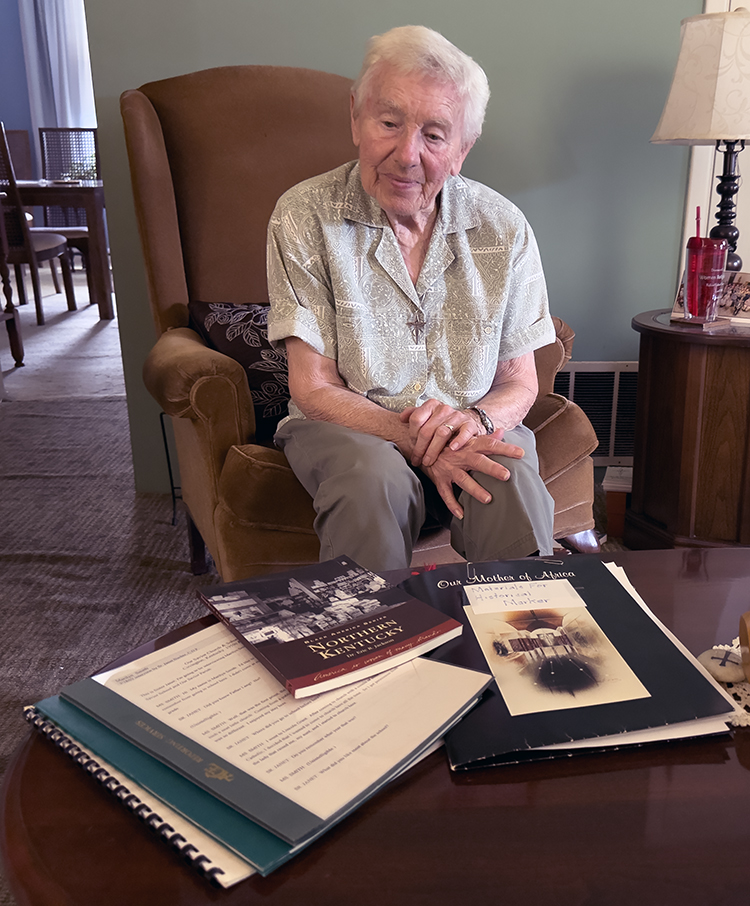
Sister Janet Bucher, July 2025. Photo by David Rotenstein.
Sister Janet Bucher was one of the first people I met after moving to Covington, Kentucky, last summer. Before the move, I had subscribed to City of Covington email lists promoting future events in our new home. A historical marker dedication caught my eye.
I attended the event at Covington’s Church of Our Savior and quickly switched from new resident mode into journalist and historian mode. During the event, I shot photos and interviewed key participants, including the powerhouse who initiated the marker project: Sister Janet Bucher. Later that day, I pitched a story to a local newsroom and it came out a few weeks later.
After Sister Janet retired, I wrote about her life and career in a second article.
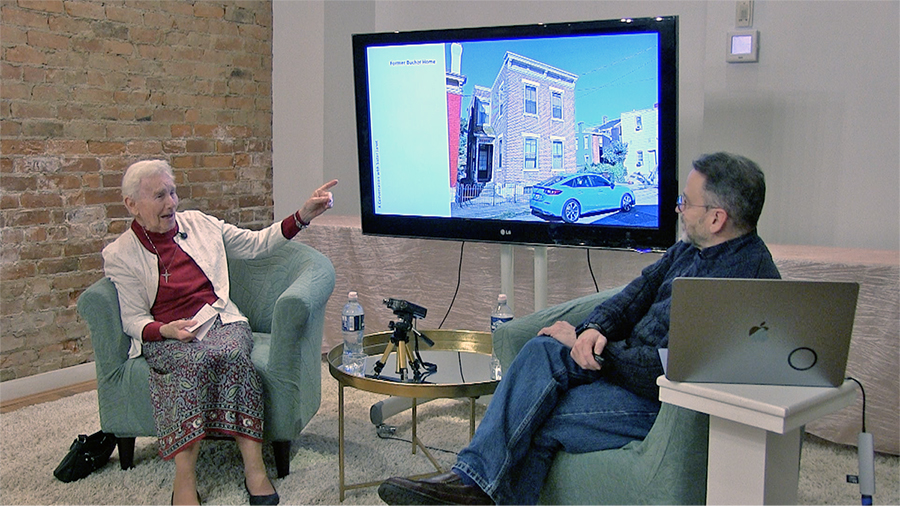
More interviews followed and it quickly became apparent that Sister Janet’s story is an important part of Covington’s history. I wanted to share the experiences beyond the printed page and I conceived a program that involved me interviewing Sister Janet before a live audience. The program took place Jan. 8 and it included the live interview, a brief slide show that illustrated her life in Covington and her career, and a discussion with the audience.
A Conversation with Sister Janet, Jan. 8, 2026.
The program is available on YouTube. Additional copies will be donated to the Kenton County Public Library’s Local History & Genealogy Department.
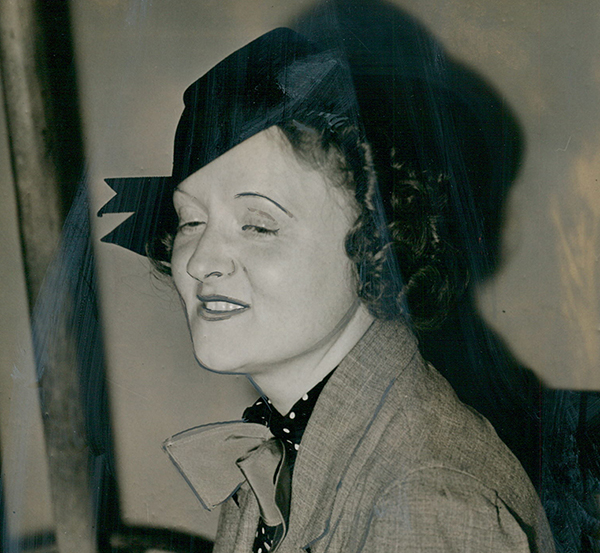
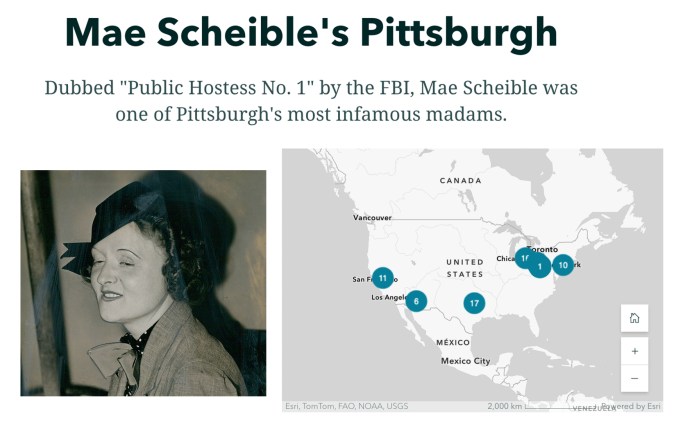
While researching a feature story on the history of brothels and sex work in Pittsburgh, I tried to wrap my head around Mae Scheible’s incredible story. Her name appears in several overviews of vice history in Pittsburgh. Yet, her story (and place in local and national history) has been eclipsed by legends attached to another well-known Pittsburgh madam, Nettie Gordon.
As I dug deeper into Scheible’s story, I realized there was a lot more to her than the existing published record. Researching someone like Scheible is a challenge: to say that she had a fraught relationship with the truth would be an understatement.
The article about brothels appeared in NEXTpittsburgh on August 29, 2024. While working on the article, I began building a storymap to better illustrate Scheible’s long career and colorful life. The storymap’s first draft is now live. It’s going to take some more time to follow additional leads and update it (and likely correct it) with new information as I collect it from remote locations throughout the United States.
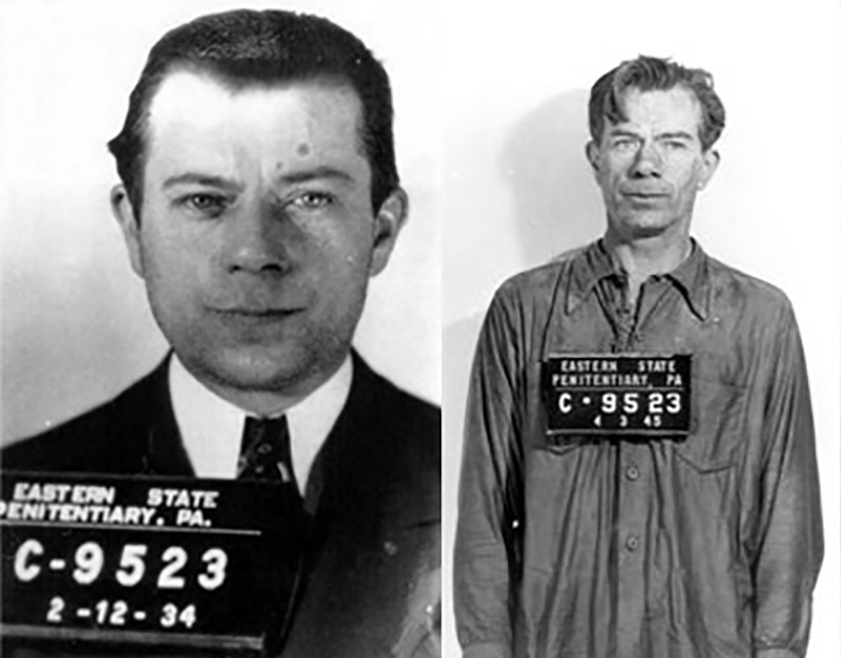
Willie Sutton was one of America’s best known bank robbers. Between the 1920s and 1950s, Sutton grabbed headlines by pulling off daring robberies and audacious jailbreaks. He became infamous for things that he did and things simply attributed to him, including the answer he allegedly gave when asked why he robbed banks.
Willie Sutton mugshots taken in 1934 and 1945 while he was imprisoned at Philadelphia’s Eastern State Penitentiary.
“Because that’s where the money is,” journalist Mitch Ohnstad said he answered. He denied the answer many times and offered his own reason: because it was fun.
Sutton spent most of his criminal career in New York City and the Philadelphia area. Briefly in late 1933, Sutton paid a visit to Southwestern Pennsylvania. On the run from the police in Philadelphia, he and a woman drove to Braddock. After Sutton’s capture in early 1934, newspapers around the nation told the story. Sutton himself recounted it in his 1976 autobiography, Where the Money Was.
Braddock was a steel town a few miles out of Pittsburgh. The dirtiest, smokiest city I have ever seen. The whole town lived off the Carnegie plant. One immense steel mill and a bunch of small wooden houses begrimed with soot. It was never light, there was too much smoke in the air, and it was never dark because those open-hearth furnaces would light up the skies at night.
A shorter version of this article originally appeared in the Fall 2022 edition of the Reporter Dispatch, the newsletter of the Allegheny City Society.
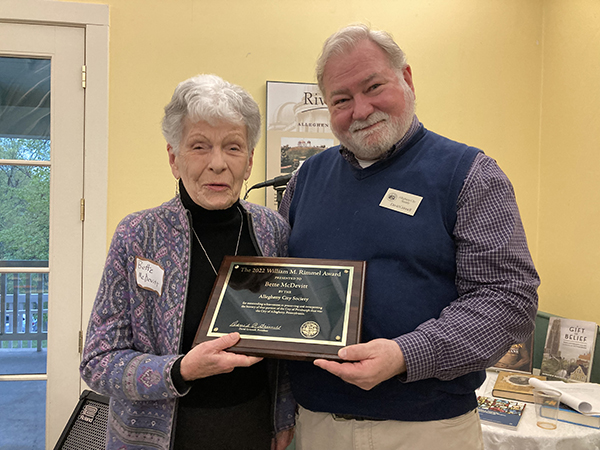
Pittsburgh writer and North Side resident Bette McDevitt received the 2022 William Rimmel Award. Bette writes about Pittsburgh history and her “Neighborhood Stories” columns appear in the Sen. John Heinz History Center magazine, Western Pennsylvania History. Though Bette grew up in New Castle, her family has deep ties to the North Side.
Bette McDevitt and Allegheny City Society President David Grinnell with her 2022 William Rimmel Award plaque. Photo by Tom Wilson.
At the May 4 annual meeting, Allegheny City Society President David Grinnell introduced Bette. David explained how he first met her while he worked as an archivist for History Center predecessor, the Historical Society of Western Pennsylvania. Just before the awards ceremony, David reinforced the meeting’s theme, storytelling, by inviting attendees to pick a theme from cards placed on each of the tables inside Riverview Park’s Chapel Shelter. Each person then was asked to tell a story related to a theme.
Bette’s story at her table and in her Rimmel Award acceptance speech drew from memories of Pittsburgh’s once rich numbers gambling culture. Numbers is an informal and illegal daily street lottery that arrived in Pittsburgh in the 1920s. It was an African American invention introduced in Harlem in the years just after the turn of the twentieth century. The game relied on a three-digit number derived from daily financial market returns published in daily newspapers. If bettors picked the correct three-digit number, they could convert a nickel into $30 and a dime into $60 — much more than the average pay for many Pittsburgh residents.
The numbers racket supported a large ecosystem of racketeers — runners, writers, and bankers — as well as people who owned the front businesses that doubled as numbers stations: barbershops, cigar stores, and pool rooms. These folks handled the racket’s supply side; housewives, millworkers, and city employees comprised a large pool of potential winners looking for just one big “hit.”
The North Side had its share of infamous numbers bankers, including Jack Cancelliere (who owned the longtime mob hangout, the Rosa Villa restaurant at East General Robinson and Sandusky Street) and Phil Lange whose exploits including backing the ill-fated Guyasuta Kennel Club in O’Hara Township the summer of 1930. And, Art Rooney — a close Lange partner and friend — was the biggest gambling boss of them all with gambling joints and speakeasies in several North Side locations.
Bette’s family wasn’t part of that crowd.
At the May meeting, Bette recounted a summertime visit during the 1940s to her aunts and grandmother, who lived in a house on Brighton Place. Bette was about 12 years old at the time. She described being handed some coins wrapped in paper with a note instructing the numbers writer down the street how to play the bet.
“Three women, plus my grandmother, who was an important person there — they all played the numbers,” Bette recalled in a subsequent telephone interview. “They all played the numbers and in the morning when they woke up, they got the dream book out to see which numbers they should play.”
Bette remembered taking the bet to a Charles Street store. Bette’s Aunt Jen usually took the daily bet. “One day, she told me that I could do that and be the runner,” she said.
Like many Pittsburgh families, numbers was an important part of daily life in Bette’s family’s household. Her aunts and grandmother lived in an apartment above a barbershop run by a man named Henry. “He used to come up the steps every day to the apartment and stand on the top step and he would ask, ‘What was the number today?’”
Playing the numbers was just another daily routine, like cooking dinner, grocery shopping, or picking up the mail. After we spoke, Bette dug into her family records and came up with some letters written by her grandmother. She quoted one to me in a May 2022 email. “Doris was lucky on the numbers,” Bette’s grandmother wrote about her other granddaughter, Bette’s sister. The letter, signed “Mum,” continued,
Called me on Monday play 108 ten cents a day. It came up the same day. So she told me to keep the 4 dollars. I sent her the fifty dollars. So the next week she called again play 315 ten cents a day came up the second day she played it. Sent her fifty dollars again. Irene had it too. Won two days straight. Doris said she figured out when her baby would be born it was 315. I buy a treasury ticket every week. If you have the whole five numbers you win eleven hundred dollars. I play every day. So it came out in the paper 26632. I had 20632 I got 5 dollars for the last three numbers. Sometime I may get it. Doris sure cleaned up. Got the ten-cent jackpot. Ed got the 5 cent one. Mother 60 dollars on the crap. Poor Dad nothing. Rose Mary is going to be operated on Sat. I’ll say good-by with love to both of you.
Though Bette only spent one week in the apartment that summer, the experience made an indelible mark in her memory. That memory is now part of a polished storytelling repertoire. Bette explained, “When I do tell people that, it seems so unlikely to them, you know, this white-haired old lady that was a messenger or whatever it’s called. It gets a great reaction from people because it’s out of character for me.”
Bette also credits those fond memories for influencing her move to the North Side. Like many good historical storytellers, Bette uses the built environment to teach people about the past in an entertaining way. “I moved here, to this neighborhood, probably because of all the good memories I have from being around here,” she confessed in our interview. “I can find family sites all over the Northside.”
Michelle Slater loves history. That’s a good thing because her family’s story is woven into Pittsburgh’s Hill District’s history about as tightly as one can get. Slater’s grandmother wrote numbers for some of the Steel City’s best known numbers bankers. Her father cut hair and eventually ran the Crystal Barbershop, one of the Hill’s most iconic third places and Black-owned businesses. Slater, 58, herself learned the hair trade watching her father and she eventually became a licensed barber herself. That’s right, not a hairstylist, a barber. One wall inside her shop is dedicated to telling her family and community’s stories. There’s a lot to unpack inside Slater’s shop and her stories.
I met Slater while researching the social history of numbers gambling in Pittsburgh. Her father, Harold Slater (1924-2014), had cut the hair of a gregarious and well-loved numbers banker and nightclub owner, George “Crip” Barron (1924-2001). On Saturdays, Barron spent time with Angela James, whom he treated like a daughter. Barron would drop Angela off at the Hurricane bar next door to the Crystal Barbershop where she would drink Shirley Temples while he tended to busines and to his hair. After I interviewed Angela James for the first time in January 2021, she connected me to Michelle Slater.
Before I get into Slater’s story, it’s important to underscore the significance of the two intersecting traditions that dominate it: numbers gambling and barbering. Invented in Harlem in the first decades of the twentieth century, numbers gambling was a street lottery that formed the economic engine sustaining many twentieth century urban, rural, and suburban Black communities. The game enabled multitudes of small bettors to wager pennies, nickels, dimes, and quarters on three-digit numbers derived from financial market returns published in daily newspapers.
With payoffs at 600-to-one, a big hit could yield anything from a dinner out to a down payment on a house. That’s how the late Colin Powell’s family bought its first home. Most gamblers, however, weren’t lucky and many found themselves betting money that otherwise would have gone towards rent and food. Numbers played off a dream of Black freedom and prosperity with long roots in this nation dating back at least to carpenter Denmark Vesey’s 1799 lottery win that enabled him to buy his freedom in South Carolina.
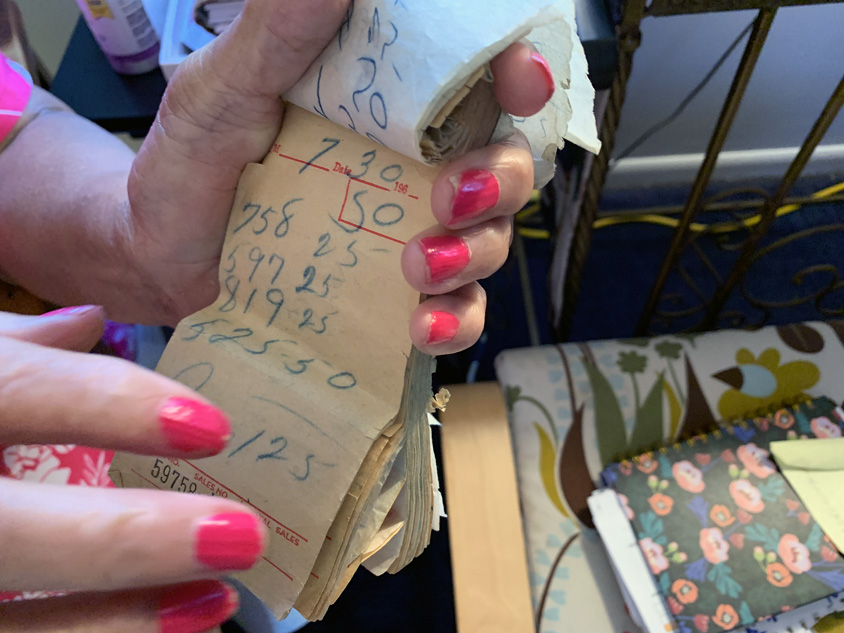
Dolores Slater holds her mother’s last numbers book. The final entries were made in the summer of 1960s, shortly before Louise Harris died. Photo by David S. Rotenstein.
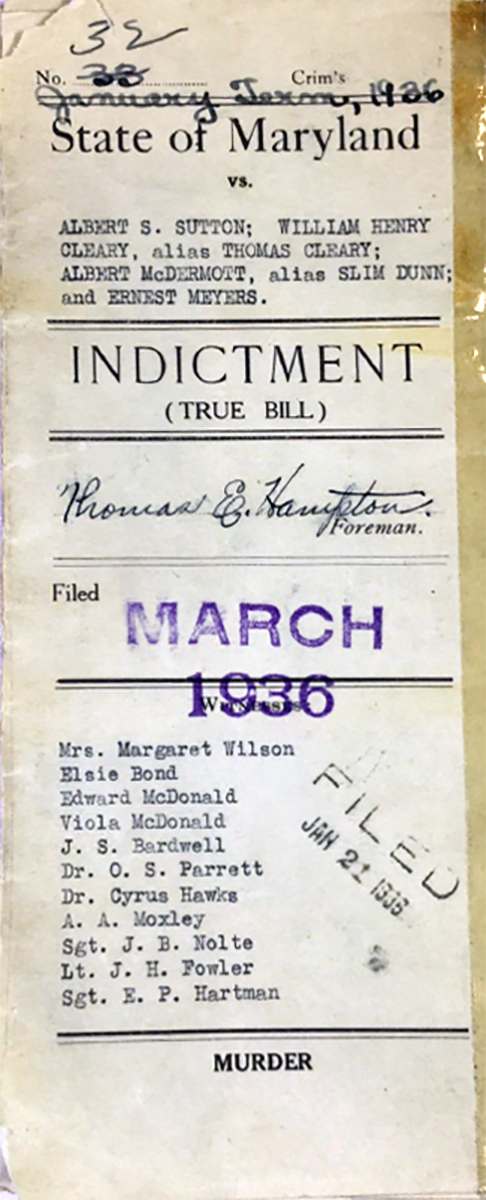
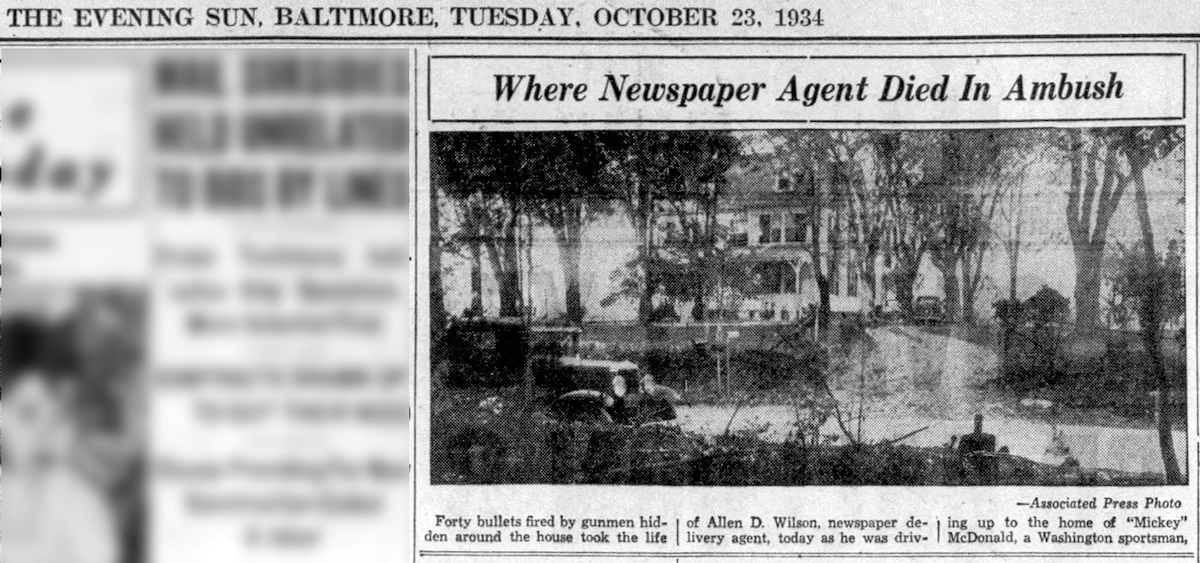
Obsessed is probably too strong of a word to describe my interest in the October 1934 turf war among two Washington, D.C. gambling entrepreneurs. But, I have had a very keen interest in the case ever since 2019 when I first read about it while working on the Talbot Avenue Bridge Historic American Engineering Records (HAER) report. It had been nearly four years since my first interviews with an aging Washington, D.C., former journalist had turned me onto the historical significance of numbers gambling. By the time that my research took me to the Takoma Park, Md., driveway where a notorious mob hitman gunned down newspaper employee Allen Wilson, I was hooked.
The free virtual program covers the history of racketeering and numbers gambling in the D.C. burbs, from the Black gambling entrepreneurs who ran the numbers in rural African American communities throughout the mostly rural suburban county to the white D.C. kingpins who made their homes there to complicate law enforcement efforts to rein them in. The so-called “Mistaken Identity Murder” caps the program as I connect the dots on one of the D.C. area’s most sensational gangland killings.
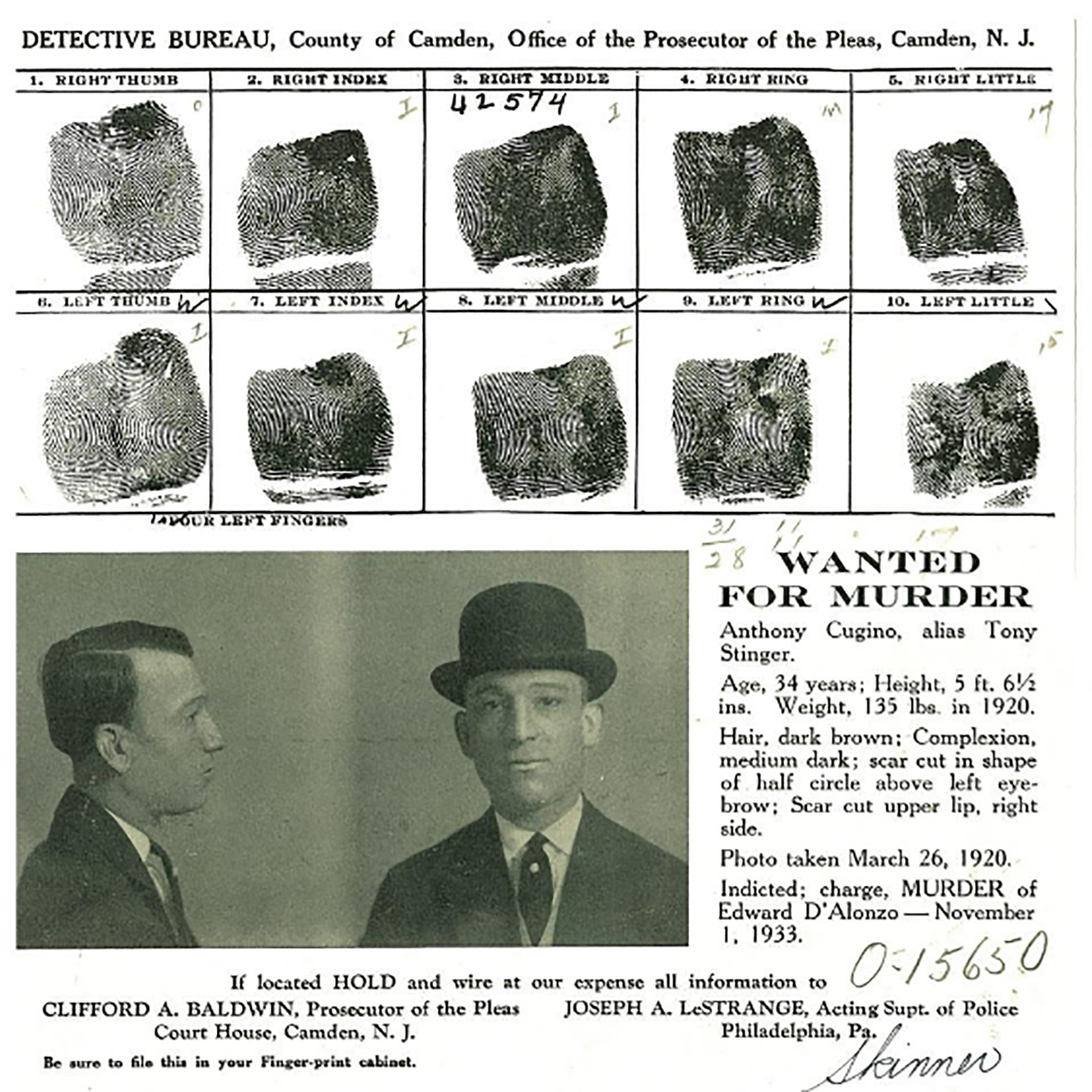
The alleged hitman, Tony “The Stinger” Cugino, was one of the East Coast’s most feared killers. In my “Squirrel Hill by the Numbers” walking tours, participants visit the site where Cugino allegedly dumped the body of one of the loose ends he cleaned up earlier in 1934 before killing Wilson. With Cugino, it’s always “allegedly” because he never made it to trial, for the Wilson murder or any of the others attributed to him. The official reports were that he hanged himself in 1935 in a New York City jail cell after the police finally caught up with him. By that time he had been suspected in hits all throughout the mid-Atlantic and upper South, including another infamous Montgomery County murder case (the “Chevy Chase Car Barn Murders“) just a few months after Wilson’s “Mistaken Identity Murder.”
Come for the numbers history and stay for the murder!
Baltimore Sun, Oct. 23, 1934.
Beyond the Zoom room
The Silver Spring program is the second of three lectures on racketeering history I’m giving this month. Pittsburghers can drop in on “Cold Storage and Real Luck” at the Lawrenceville Historical Society July 20. There were mobsters on 1500 block of Penn Ave. in Pittsburgh and the story of the city’s giant refrigerator building and Pittsburgh’s most aptly named bar has several good rackets chapters.
On August 1, just a few days before Pittsburgh’s infamous 805 episode‘s 92nd anniversary, I’m speaking to the Moon Township Historical Society. Tony “The Stinger” and his 1934 visit to Pittsburgh may or may not be on the program but lots of Steel City vice will be.
Wanted Poster for Tony “The Stinger” Cugino. United States Postal Inspection Service Bulletin, Oct. 2003.

 COVert NKY