“Mistaken Identities” and murders

Obsessed is probably too strong of a word to describe my interest in the October 1934 turf war among two Washington, D.C. gambling entrepreneurs. But, I have had a very keen interest in the case ever since 2019 when I first read about it while working on the Talbot Avenue Bridge Historic American Engineering Records (HAER) report. It had been nearly four years since my first interviews with an aging Washington, D.C., former journalist had turned me onto the historical significance of numbers gambling. By the time that my research took me to the Takoma Park, Md., driveway where a notorious mob hitman gunned down newspaper employee Allen Wilson, I was hooked.

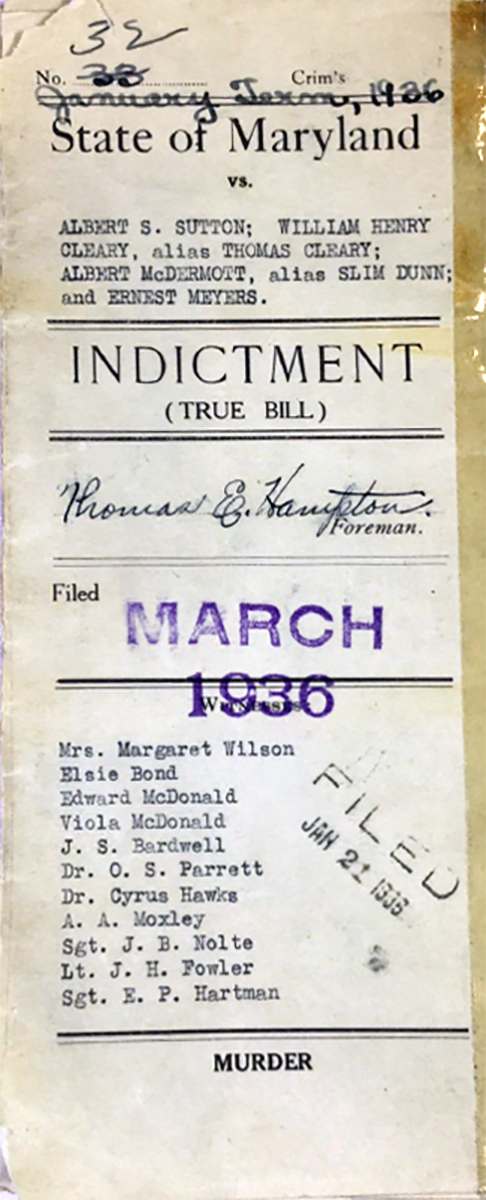
Indictment in Wilson murder case.

On July 25, I’m continuing the mini-mob-lecture circuit with a talk on racketeering in the D.C. suburbs: “The Numbers Game in the Burbs: Racketeering in Montgomery County.”

The free virtual program covers the history of racketeering and numbers gambling in the D.C. burbs, from the Black gambling entrepreneurs who ran the numbers in rural African American communities throughout the mostly rural suburban county to the white D.C. kingpins who made their homes there to complicate law enforcement efforts to rein them in. The so-called “Mistaken Identity Murder” caps the program as I connect the dots on one of the D.C. area’s most sensational gangland killings.

The alleged hitman, Tony “The Stinger” Cugino, was one of the East Coast’s most feared killers. In my “Squirrel Hill by the Numbers” walking tours, participants visit the site where Cugino allegedly dumped the body of one of the loose ends he cleaned up earlier in 1934 before killing Wilson. With Cugino, it’s always “allegedly” because he never made it to trial, for the Wilson murder or any of the others attributed to him. The official reports were that he hanged himself in 1935 in a New York City jail cell after the police finally caught up with him. By that time he had been suspected in hits all throughout the mid-Atlantic and upper South, including another infamous Montgomery County murder case (the “Chevy Chase Car Barn Murders“) just a few months after Wilson’s “Mistaken Identity Murder.”

Come for the numbers history and stay for the murder!
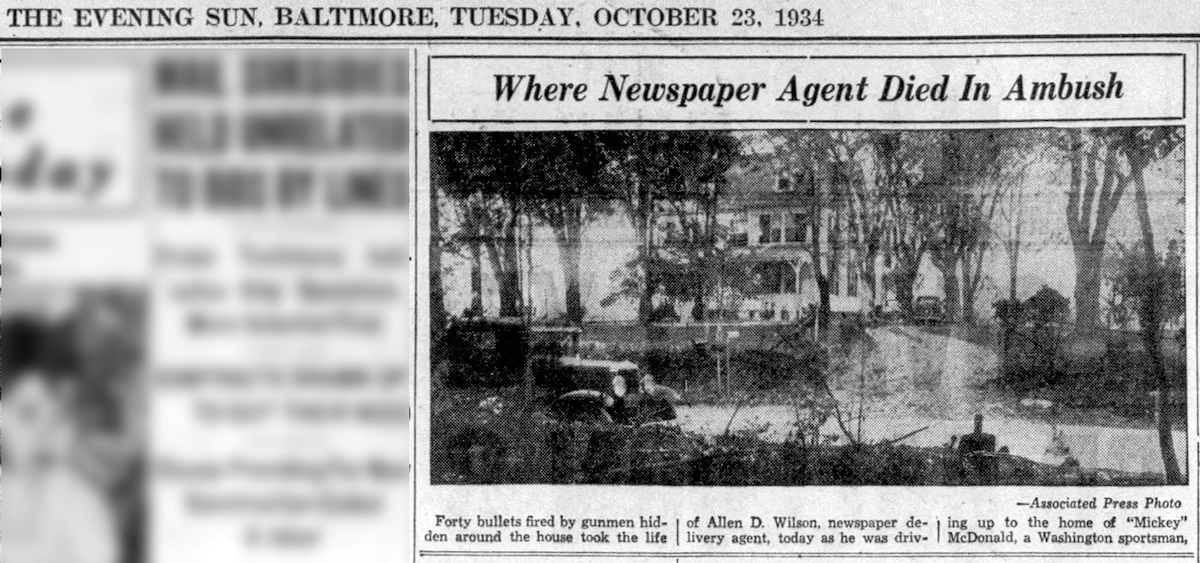
Baltimore Sun, Oct. 23, 1934.

Beyond the Zoom room

The Silver Spring program is the second of three lectures on racketeering history I’m giving this month. Pittsburghers can drop in on “Cold Storage and Real Luck” at the Lawrenceville Historical Society July 20. There were mobsters on 1500 block of Penn Ave. in Pittsburgh and the story of the city’s giant refrigerator building and Pittsburgh’s most aptly named bar has several good rackets chapters.

On August 1, just a few days before Pittsburgh’s infamous 805 episode‘s 92nd anniversary, I’m speaking to the Moon Township Historical Society. Tony “The Stinger” and his 1934 visit to Pittsburgh may or may not be on the program but lots of Steel City vice will be.
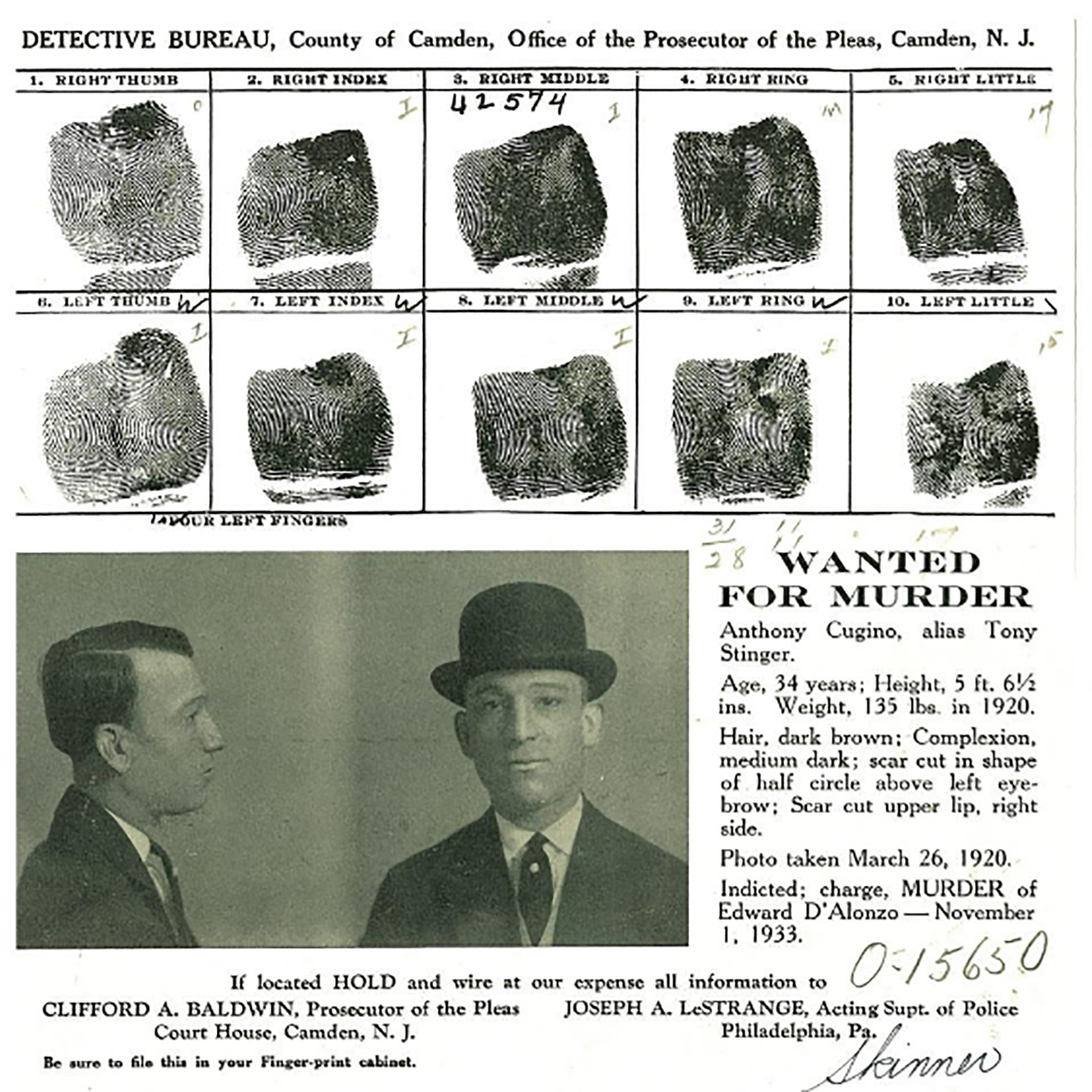
Wanted Poster for Tony “The Stinger” Cugino. United States Postal Inspection Service Bulletin, Oct. 2003.

© 2022 D.S. Rotenstein

Welcome to “Mobsburgh”: Morris Kauffman’s last ride

Last summer I inadvertently stumbled upon a story about organized crime in Pittsburgh, Pennsylvania. Since August, I have been poring through archival records, historical newspapers, and interviewing the descendants and extended kin of people involved in Pittsburgh’s gambling and bootlegging rackets between 1920 and 1980. As I work my way through this research I will be posting stories in this space: #Mobsburgh.

The first #Mobsburgh story begins far away from Pittsburgh in the U.S. 301 and U.S. 1 highway corridors between Richmond, Virginia, and Philadelphia, Pennsylvania. In 1933 and 1934, a loosely organized crew committed a string of robberies and murders. They were called the “Tri-State Gang” for the territory (Pennsylvania, Maryland, and Virginia) where they operated.

Pittsburgh was a bit far afield for the gang, best known for hijacking cigarette trucks out of North Carolina and for robbing postal facilities in Washington, D.C., and Richmond. Yet, their crime spree extended to Pittsburgh in 1934 when the body of one of the gang members was found behind an apartment building in the city’s emerging Jewish neighborhood, Squirrel Hill.

Wendover Apartments, Squirrel Hill, December 2019.

The Baltimore evening Sun, May 23, 1934. Source: newspapers.com

Continue reading

A Hit on Joe Tito?

A Family Business

Nineteen thirty-two was a turbulent year in Pittsburgh organized crime history. Prohibition was winding down and the city’s racketeers were positioning themselves in a world where liquor and beer would again be legal. Turf wars in the Steel City were local dramas set within a larger story where such racketeers as Charles “Lucky” Luciano and Meyer Lansky were solidifying their hold over a national organized crime syndicate (frequently dubbed La Cosa Nostra). In 1931, Luciano became the syndicate’s leader following the brutal murders of Joe “The Boss” Masseria and Salvatore “Boss of all Bosses” Maranzano. Giuseppe “Joe” Siragusa, Pittsburgh’s “Yeast Baron,” was brutally killed in his Squirrel Hill home that year. Assassinations and violent warnings were the tools of the trade.

Joe Tito (1890-1949) was a major figure in Pittsburgh’s rackets by the time Luciano formed his commission and national vice network. He was born in Bloomfield and had grown up in Soho, where his father Raphael had bought several properties on Gazzam Hill starting in the mid 1890s. On paper, Raphael worked as a street lamp lighter, but his rapid rise from Bloomfield renter to Soho landlord, suggests some off-the-books enterprises. A number of “Black Hand” bombings and threats involving people living in his properties offers some hints as to what the source of his wealth might have been.

Raphael and Rosa Tito. Photo courtesy of Rona Peckich.
Continue reading

Ghosts and gangsters: 1129 Ridge Avenue, “America’s Most Haunted House”

Screen capture, 13 Creepy Pittsburgh Ghost Stories, http://www.pittsburghbeautiful.com

While researching organized crime in Pittsburgh I stumbled upon a colossal haunted house story. My work documenting the history of a Pittsburgh family with two generations of bootleggers and numbers racketeers inadvertently led me to 1129 Ridge Avenue in Pittsburgh’s Northside neighborhood. The family I am researching was associated with the family that owned 1129 Ridge Avenue for more than 30 years.

By the last decades of the twentieth century, stories attached to the property had earned 1129 Ridge Avenue the dubious title, “America’s most haunted house.” This post, which began as an article for a community newspaper, documents how a modest 1880s home became fodder for decades of contemporary legends.

Continue reading