Willie Sutton was one of America’s best known bank robbers. Between the 1920s and 1950s, Sutton grabbed headlines by pulling off daring robberies and audacious jailbreaks. He became infamous for things that he did and things simply attributed to him, including the answer he allegedly gave when asked why he robbed banks.
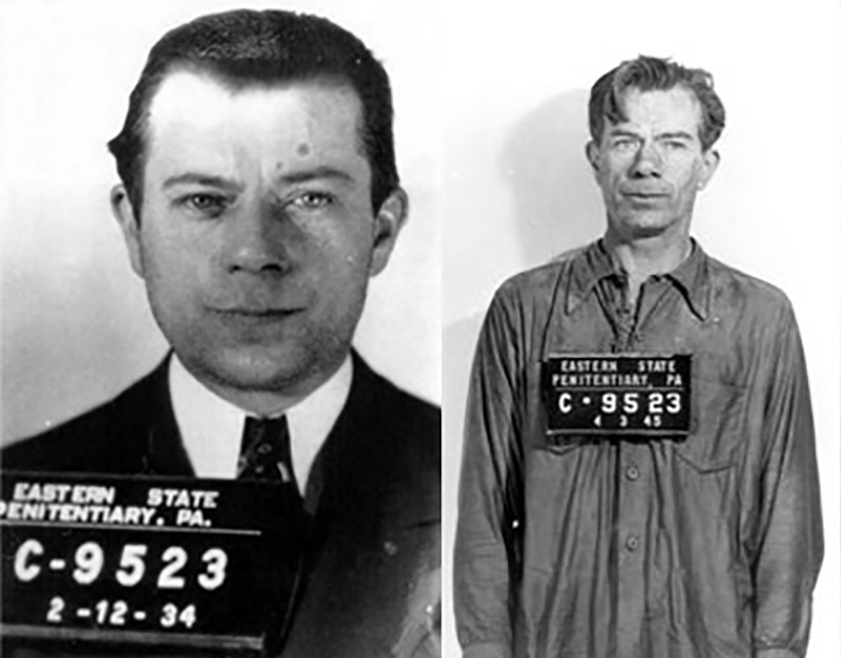
“Because that’s where the money is,” journalist Mitch Ohnstad said he answered. He denied the answer many times and offered his own reason: because it was fun.
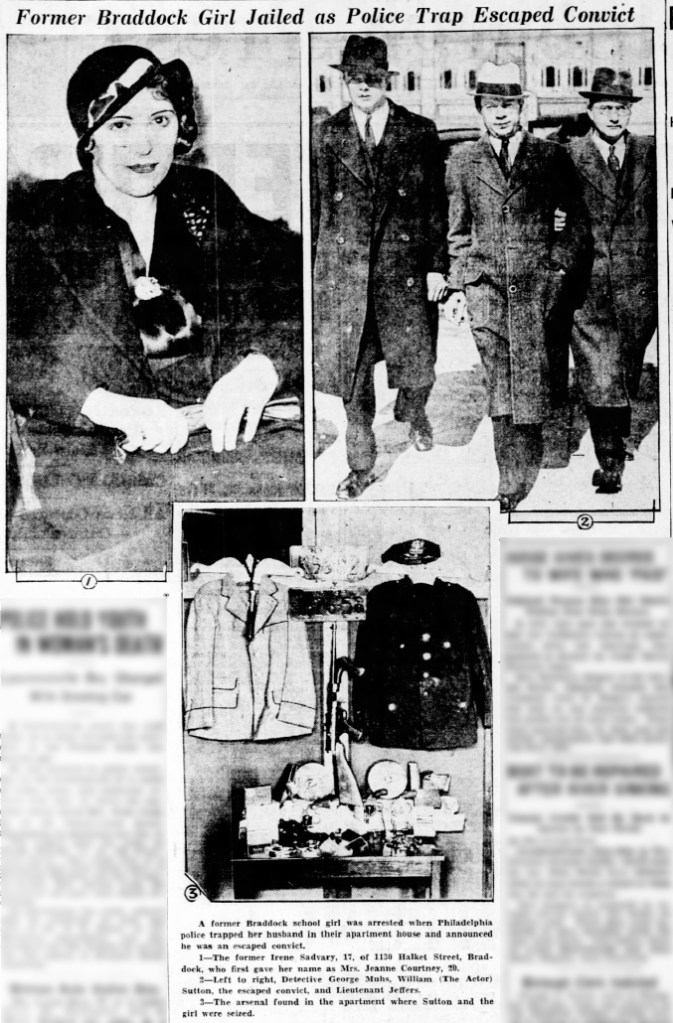
Sutton spent most of his criminal career in New York City and the Philadelphia area. Briefly in late 1933, Sutton paid a visit to Southwestern Pennsylvania. On the run from the police in Philadelphia, he and a woman drove to Braddock. After Sutton’s capture in early 1934, newspapers around the nation told the story. Sutton himself recounted it in his 1976 autobiography, Where the Money Was.
Braddock was a steel town a few miles out of Pittsburgh. The dirtiest, smokiest city I have ever seen. The whole town lived off the Carnegie plant. One immense steel mill and a bunch of small wooden houses begrimed with soot. It was never light, there was too much smoke in the air, and it was never dark because those open-hearth furnaces would light up the skies at night.
In Braddock, he stayed with his girlfriend’s family. He called her Olga Kowalska In the book; her real name was Irene Sadvary.
Sutton wrote:
So I met Olga’s people, her father, her mother, her brother. Her father had lost his leg in an accident after working in the mills all his life, but that didn’t stop him. He was a bear of a man. It was a Russian and Polish community, with maybe a Hungarian thrown in here and there, and it seemed as if they had the whole town in there, dancing the mazurkas and polkas and drinking corn liquor out of ketchup bottles.
Of all the things Sutton encountered in Braddock, he dedicated the most words to one subject: numbers gambling:
This is 1933 now, and as poor as the community had always been, the Depression was really biting in. Like poor poor people everywhere, their great hope was to hit “the number.” It was all so much in the open that the numbers writer would go from door to door, like the postman, and make out the bets in triplicate. They weren’t even paying anybody off. Boy, I thought, Dutch Schultz would love this.
Well, I had come driving up in a brand-new Buick, which made me a celebrity right there. My license plate had three numbers 368, and the whole neighborhood plunged on it. The number came out, and that’s when I found out what it was really like when Russians and Poles have a celebration.
Sutton and Sadvary returned to Philadelphia. He was captured and the police briefly detained Sadvary. He returned to prison and she went back to Braddock. In 1937, she married steelworker George Torbich. Though she told reporters and police officers in 1934 that she and Sutton had been married in Maryland, Sadvary’s 1937 marriage license indicated that her marriage to Torbich was her first. Sutton died in Florida in 1980 and Irene died in 2004.
©2024 D.S. Rotenstein
 COVert NKY
I love this site. I grew up in Pittsburgh and there is so much about it that I did not know about. I loved when my grandma “Honey” would tell her stories about their lives in our region. Now I depend on site like yours and my cousin Brian Butko for addition knowledge. Thank you all! Such wonderful articles.
LikeLike